Stop Guessing: Why Your Next Message Needs Video Design Thinking (Not Just a Cool Camera)
We’ve all sat watched a slick new corporate video before, and thought… “That looks great, sounds great. But what is it for?”
You’ve probably also felt the sting of one these “Expensive Marketing Gambles”. You sign off a five-figure budget, cross your fingers, and hope the final video does something. Anything.
The problem? Most video projects fail before the camera even rolls. Why? Because they’re built on assumptions, not insight. Assumptions by experts no doubt, but still estimated guesses. They also lack that single, measured goal.
At Film Division, were here to change that. We believe for a video to be a worthwhile investment, it must do more than just exist; it must create a real-life change in its audience. Our process is designed to transform video from a gamble into a powerful strategic tool.
Our Antidote: Video Design Thinking
Here’s our secret: our core expertise isn’t just in one video genre. We’re not just charity video people or just sustainability video people.

Our expertise is in a universal video design thinking process aimed at unearththing brilliant video concepts and campaign strategies, no matter the sector. It’s why we can partner with massive organisations one day and campaign groups the next.
Our process is designed to do two things:
-
First, broadly explore your problem or goal from every conceivable angle.
-
Then, meticulously narrow it down through evaluation, research, and experimentation to find a solution that actually works.
Why Bother?
We can hear you now. “We don’t have time for this! We just need to start shooting!”
It’s the single biggest pushback, and we get it. But here’s the kicker: this process saves you time and money.
Instead of spending your entire budget on one big-bang production based on a “good idea” from a few createive meetings, our process lets you fail and learn as fast as possible on a small scale. It’s built for collaboration and ensures we’re all on the same page before the costly production phase.
Yes we have the knowledge and experience to have a pretty good guess on a concept that will work. But would you rather commit between 20 and 150k of your budget on a gamble or on a tried and tested tool?
What is Video Design Thinking?
Design Thinking is a human-centred approach to innovation. For video, it means we integrate the needs of your audience, the possibilities of technology, and your campaign goals.
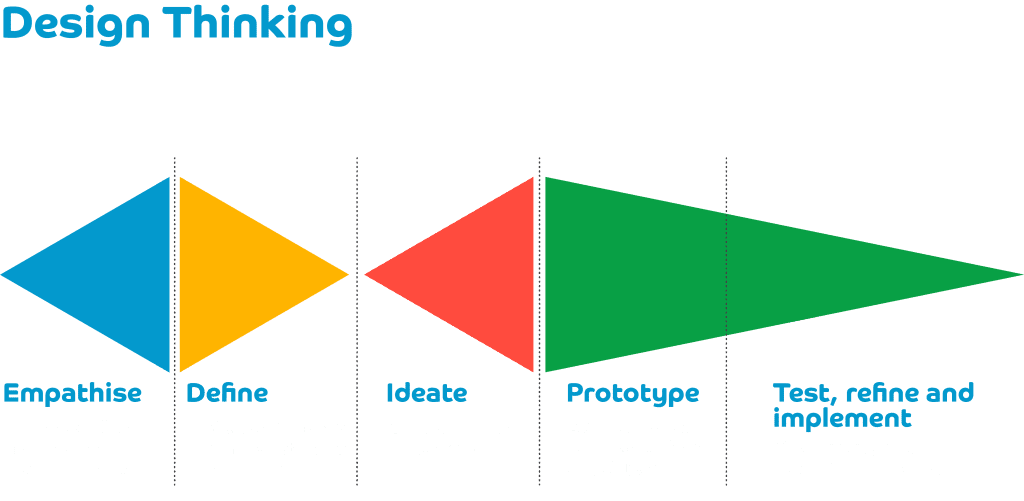
Video Design Thinking is a five-step loop that moves from broad to narrow:
-
Empathise & Define: This is the broad exploration. We get under the skin of your audience and clearly define the problem we’re solving together.
-
Ideate: We go wide again, generating a lot of creative solutions and ideas.
-
Prototype: This is where the narrowing begins. We build tangible, testable versions of the best video design thinking ideas.
-
Test & Refine: We test these prototypes, learn, adapt, and iterate.
-
Implement: Only after we have a validated, rock-solid concept do we get the cameras out and go into production.
Embracing “Controlled Chaos”

True innovation rarely emerges from rigid, over-planned strategies or a stiff boardroom meeting where everyone is afraid to say the wrong thing. To get to a solution that actually changes behaviour, we need to break the mould. We need to embrace “Controlled Chaos.“
This doesn’t mean being messy or disorganised. It is a deliberate, strategic phase of our video design thinking process that shatters preconceptions.
Here is how it works:
-
The “Chaos” (Going Broad): We start by throwing the doors wide open. We bring together our eclectic, empathetic team and encourage a flood of ideas. We defer judgment entirely—no idea is “too expensive” or “too silly” at this stage. This is where we also introduce the ‘Wild Card’—a bold, perhaps even slightly bonkers idea designed specifically to challenge the status quo. We use it to stretch the boundaries of what is possible, ensuring we aren’t just repeating what’s been done before.
-
The “Control” (Narrowing Down): Once we have explored the problem from every conceivable angle, the “Control” kicks in. We stop expanding and start refining. We look at that wall of ideas and ask: Which of these actually solves the problem? Which matches the budget? Which hits the sustainability goals?
This philosophy of enlightened trial-and-error is far more powerful than waiting for a “lone stoke of genius”. By embracing video design thinking, we allow ourselves to explore broadly before we ruthlessly narrow down, we ensure the final concept isn’t just the safest option—it’s the right one.
Prototyping: Showing, Not Just Telling
Picture this; you and your team read a script, and you all smile and nod. Based on your combined experiences, your target audience should love this. But it misses the mark, it’s not what your target audience care about. You don’t realise you are making a film for yourself until the final edit lands—and by then, it is too expensive to fix.

This is why we live by a particular principle in the video design thinking process of Doing > Thinking.
Instead of endless meetings debating abstract concepts, we build Prototypes. A prototype is a tangible, visible, and testable version of a video idea. It acts as a decision-making tool to answer open questions before the expensive meter starts running on a film set.

What does a video design thinking prototype look like? It isn’t a wobbly video shot on a phone (unless that’s the style we are testing!). It might be:
-
A Mood Film: A ‘brand rip’ using stock footage and other video to test the emotional tone and pacing.
-
An Animatic: Rough sketches set to a temporary voiceover to test the narrative flow.
-
A Table Read: Hearing the script performed out loud to ensure the tone lands correctly.

The Cycle: Make > Test > Learn > Adapt
The prototyping stage of the video design thinking process allows us to embrace the cycle of Make > Test > Learn > Adapt. We can show a rough animatic to a sample of your audience and ask, “Do you understand what this means?”
If they don’t, we haven’t wasted £20,000 on a film shoot. We’ve just wasted a few sheets of paper and an afternoon. We tweak the idea, refine the message, and test again. By the time we move to production, we aren’t hoping the video concept works; we know it works.
Our Goal: Real, Measurable Change

A “nice” video is just… nice. It might get a few likes on LinkedIn, but does it pay the bills?
We believe that a video without a measured goal is just digital wallpaper. Our entire video design thinking process—from the chaos of ideation to the precision of prototyping—is geared towards transforming video from an expense into a high-performing asset.
We don’t just aim for views, we aim for the righ views that will increase sales and engagement by engineering content that delivers tangible results. When video is designed with empathy and strategy, the potential returns are massive.
While the specific KPIs will depend on your unique needs, here are some powerful examples of what is possible—though we are certainly not limited to these:
-
Dominate Search Engines: Create video content to increase organic web traffic by 157%.
-
Convert Leads: Produce landing page video to improve website conversion by a staggering 86%.
- Improve Your Sales Funnel: Design video content to get 66% more qualified leads into your sales funnels.
-
Accelerate Growth: Generate revenue 49% faster by utilising strategic video marketing.
-
Be Remembered: Utilise video content for improving brand recognition by up to 54%.
We aim for a 30% behavioural change in your target audience. Whether that is signing a petition, buying a product, or changing a habit, we want them to do something, not just watch something.
How We Start: The Framework Session

We always begin our partnerships with a dedicated Framework Session.
This is the first, crucial step in our ‘broad exploration’ phase. Before a single thing is costed, we run this deep-dive investigation. This session is the difference between spending thousands on a film that might not work, and investing a small amount first to ensure your message is designed to resonate, convince, and create a lasting impact.
In this collaborative session, we nail down three things:
-
The Change: What specific, measurable action do you want your audience to take?
-
The Audience: Who are they really? Where are they, and what do they actually care about?
-
The Brand: What is your unique identity, and what can you offer this audience?
Moving straight to production without this is a gamble. We’d rather not gamble with your budget.
We want to be at your side, not just as your video suppliers, but as your strategic partners.
Conclusion
The era of the “video supplier” who just turns up and shoots is ineffective in a noisy digital landscape. To really make an impact, you need a partner who understands the architecture of persuasion.
By adopting our video design thinking process, you aren’t just buying a video; you are investing in a rigorous, creative journey designed to solve your specific organisational problems. Whether it is driving sales, changing public perception, or rallying a community, the process remains the same: broad exploration, controlled chaos, ruthless refinement, and measurable impact.
Don’t let your next campaign be a shot in the dark. Let’s turn the lights on.
Ready to stop gambling and start video design thinking up content that actually works? You can download a free copy of our framework using the form.