“Quality” Video Production: The True Investment Your Brand Needs to Succeed
As a marketer, when you “use video” you want it to be a quality video production right? But here lies a common pitfall: treating video production as a simple tick-box exercise. This approach almost always leads to a predictable outcome – an underwhelming video, wasted resources, and a missed opportunity to connect with your audience.

Remember, the purpose of all video content is for its audience to “do” something that they otherwise wouldn’t have if they hadn’t watched it. If an audience views a piece of content and nothing has changed within them then the video has either failed or they were not the right audience to begin with. To increase the likelihood that your video content will drive real change is a significant investment. No, we’re not just talking about the budget. We’re talking about a deep commitment of time, resources, strategic thinking, and a willingness to aim for excellence over convenience.
As a video production company driven by a creative manifesto to never compromise on quality, we know what it takes. We wrote this guide for marketing professionals like you, who want to move beyond ticking boxes and start creating video content that makes a genuine impact. We’ve got the plan, experience, and equipment, but a truly great video is always a partnership.
Defining ‘Quality Video Production’: It’s More Than Just a Pretty Picture

First, let’s define what we mean by “quality video production.” When we talk about a quality video, it’s easy to think of the technical basics: sharp 4K resolution and crisp, clear audio. While these are essential, they’re simply the cost of entry. True quality, the kind that drives results, is found in the strategic and human elements of the production. It starts with a quality story—a clear, compelling narrative that understands its audience and is designed to resonate on an emotional level. This story is then delivered through a quality performance, where the on-screen talent, whether an actor or an employee, connects with the viewer through authentic and confident delivery. It’s this combination of a powerful message and a believable performance that builds trust and makes a video memorable.
This commitment to a quality video production extends to every visual element on screen. Quality design means that every choice is intentional and serves the story. This includes the art direction of the location, the styling of the set, the wardrobe of the contributors, and the on-brand execution of any graphics. A messy background or dated animations can subconsciously undermine your message and signal a lack of care. Ultimately, this deeper quality is about purpose and intentionality. It’s the thoughtful fusion of story, performance, and design that elevates a video from a simple recording into a powerful and persuasive asset for your brand.
It’s a Partnership: You Get Out What You Put In
It sounds obvious, but you really do get back the effort you put in, and this is especially true for video production. The process is a collaboration between us, the video creatives, and you, the people whose story we are trying to tell. We can make things look fantastic on camera, but the authenticity and power of the final quality video production depend entirely on your team’s preparation and commitment.
Outside The Box: Embracing Vulnerability in Ideation
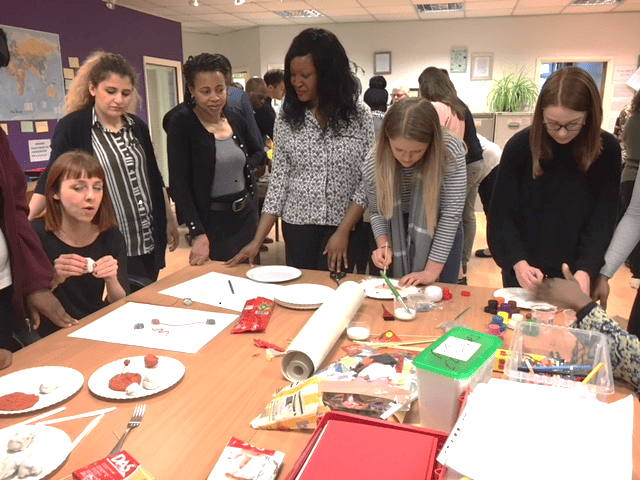
Before a single concept is developed, we enter the most crucial and creative phase: ideation. To achieve something truly exceptional, this is the stage where we ask our partners and their stakeholders to be vulnerable. This means stepping out of the corporate comfort zone and creating a space where “wild card” ideas are encouraged, not dismissed, and where we can explore concepts that challenge long-held assumptions about how your brand should present itself. This level of openness can feel unfamiliar, but it’s a direct reflection of the project’s ambition. If the goal of your video is truly business-critical—to shift market perception or attract top-tier talent—then a safe, predictable concept will not suffice. Embracing this vulnerability is what unlocks the creative potential needed to produce something truly effective and extraordinary.
Quality Video Production: Why Conceptual Effort Matters

The main reason we are working together is to produce an engaging high quality video production. This requires not only logistical preparation but, more importantly, conceptual effort. It means being willing to move beyond the easy option and invest in a creative idea that will truly resonate with your audience.
“Show, Don’t Tell”: The Golden Rule of Quality Video Production
The easiest video to make is often a series of “talking heads”—employees or managers sitting in a chair, telling the audience how great things are. This is the definition of a tick-box exercise. It’s safe, simple, and almost completely ineffective.
Audiences are sophisticated; they don’t want to be told what to think. They want to see it for themselves and reach their own conclusions. This is the power of “Show, Don’t Tell.”
- Instead of an employee saying, “I love how collaborative my job is”… SHOW a team engaged in a dynamic brainstorming session, laughing and challenging each other.
- Instead of a manager telling you, “We value work-life balance”… SHOW employees leaving on time or attending a company-sponsored family event.
- Instead of a product description listing features… SHOW a customer’s face light up with relief as the product seamlessly solves a problem for them.
Showing is more than just illustrating a point; it’s about providing evidence. It builds trust, creates an emotional connection, and is infinitely more memorable than a spoken claim.
A Practical Example: Selling the Experience
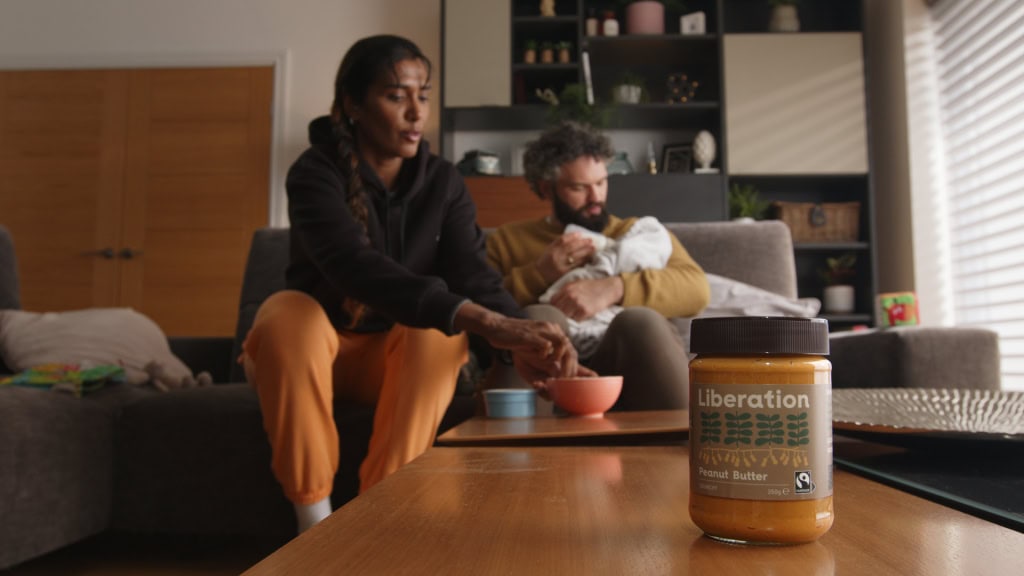
Let’s show a couple of examples here.
We were approached by Liberation Foods, who sell fair trade savoury snacks, who wanted to increase the amount of sales they have via their website.
- The “Telling” Approach (Low Effort): We film the MD in their office. They tell the camera Liberation’s mission to make sure that farmers in India and South America receive a fair income for their crop, why it’s important to them, how tasty the products are etc then CTA. The video ticks the box, but it’s forgettable.
- The “Showing” Approach (High Effort): We capture cinematic shots of their target audience in different moments in their lives. From the busy commute to parenting, to excercise and music festivals. Instead of telling them that there are products for each scenario, we “show” it. We film vibrant, mouth-watering close-ups of meals that can be made using Liberations products. Finally, we see a family who are visibly savouring every bite as they unwind from their busy lives.

CORE Education Trust commisioned us to help them with a recruitment drive for more teachers.
- The “Telling” Approach (Low Effort): We film the headteacher and other teachers around the school telling the viewer how great it is to work with children at this particular school and mention the school values. Again, bog standard bare minimum effort, but you have a recruitment video ticked off.
- The “Showing” Approach (High Effort): We’re honest with teachers, teaching is hard, but you will never have a more fullfilling job with our students. Featuring the students themselves, we invite them to rise to the challenge because we know they care. It’s heartwarming, it shows the school personality and most importantly it’s engaging!
By going that extra mile and getting the students involved, it serves as a reminder to all teachers about why they do what they do, for the students themselves.
Begin With Empathy: Ditch the Buzzwords
There’s a perilous moment in the life of almost every quality video project. The concept is strong, the story is compelling, but then the script goes out for review. Slowly, the requests start to trickle in: “Can we make sure we mention our three core brand values?”, “Let’s shoehorn in our new tagline here”, “We must include buzzwords like ‘synergy’ and ‘disruptive innovation’.” While these requests come from a good place, this is where the soul of a great video can be lost to a committee.
Let’s be direct: your audience doesn’t care about your brand values. They don’t care about them as abstract concepts, anyway. What they care about is a high quality video production that tells authentic stories, real people, and how you can solve a problem for them. When corporate jargon and buzzwords are forced into a script, viewers can feel it instantly. It feels inauthentic, it feels like a sales pitch, and it makes them disengage. It’s like trying to force a puzzle piece from a different box into a space it clearly doesn’t belong; the whole picture looks wrong.
The solution is to put your audience first and to trust in the power of showing, not telling. Like in the previous examples, instead of having an employee state, “Our culture is built on innovation,” let’s create a compelling story showing your team collaborating to achieve a genuine breakthrough. Don’t tell us your brand value is “customer-centricity”; show us by featuring a frontline team member telling a heartfelt story about helping a customer. Your brand values should be the invisible foundation of the story, not the clunky dialogue. Every element included in the narrative needs to add value for your target audience, not to keep your brand manager happy. A successful video allows the audience to feel your values through an authentic narrative, which is infinitely more powerful than just being told what they are.
Setting the Stage for Quality: Preparing Your Location

Your place of work isn’t just a backdrop; it’s a character in your brand’s story. When a film crew arrives, it’s your opportunity to show off your organisation at its absolute best.
Choosing the Right Space: Beyond the Boardroom

Try to avoid defaulting to a tiny, plain white meeting room for an interview. It’s uninspiring and does a disservice to your organisation’s vibrancy. We need to take this principle a step further: it’s not just about finding a nice space; it’s about finding the right space—a location that provides context and amplifies the speaker’s message.
Ask yourself this: if a marine biologist is passionately discussing ocean conservation, is a quiet room at your city HQ really the best place for their interview? Or would their message be infinitely more powerful if we interviewed them on a research boat, with the sea right behind them?
Similarly, if your head of engineering is explaining a breakthrough in manufacturing, what’s more convincing? Hearing them talk about it in an office, or seeing them on the factory floor, surrounded by the very innovation they’re describing? While shooting on location can be more challenging, the payoff in authentic and impactful quality video production is immeasurable.
Tidiness and Cleanliness: Reflect Your Brand’s Standards
We know that workplaces can get messy when you’re busy. However, the final video will be online for many years to come. It’s imperative that your place of work is portrayed in a way that reflects your high standards. Imagine your favourite celebrity is visiting on the same day as the shoot. Would they be impressed? A good tidy and clean before our crew arrives makes a world of difference.
Checking Your On-Site Branding
Is all the physical branding at your organisation up to date? The last thing you want is a prominent shot of an old logo or previous company name in your new high quality video production. This can confuse your audience and dilute your brand message. This check extends to everything from wall art and signage to staff uniforms and PPE.
The Human Quality: Preparing Your People
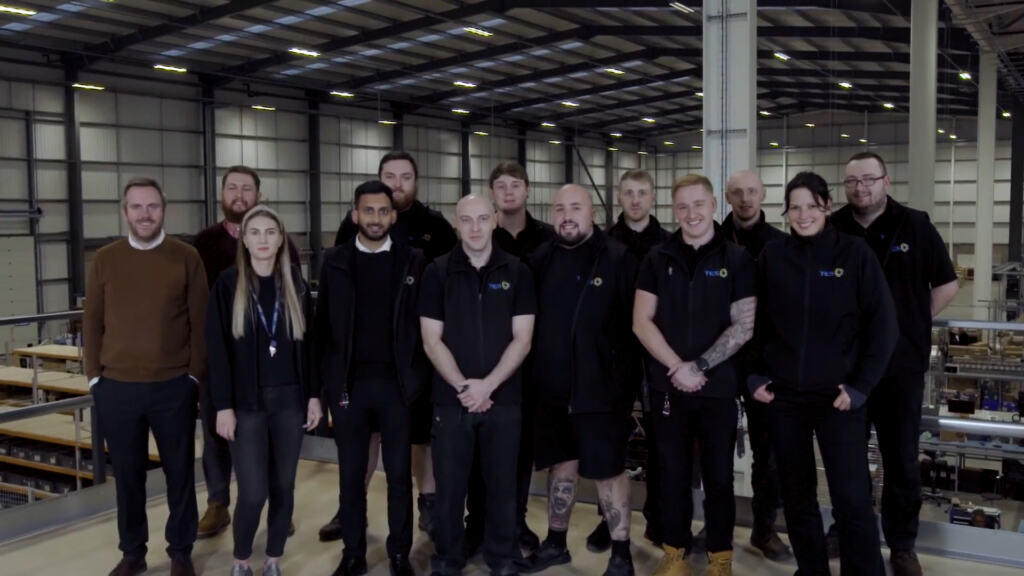
Your staff are the heart of your organisation. How they appear and what they do on camera is critical to telling an authentic and compelling story. But before we think about what they will wear or when they need to be on set, we must address the most important question: are we putting the right person in front of the camera?
Choosing the Right Contributor: Authenticity Over Authority
It’s easy to default to the most senior or readily available person for an interview. But are they truly the right person to tell the story? Authenticity is key to creating a quality video production that connects with your audience, and that comes from hearing directly from the person with genuine experience.
For example, you might want to showcase a recent breakthrough. The line manager may be well-spoken, but were they the one who made the discovery? A manager can report the facts, but the engineer who lived and breathed that problem for months can convey the passion and the triumph. That genuine emotion is what an audience connects with. When you compromise on the contributor, you compromise the core of your story.
On-Camera Interviews

Conducting powerful on-camera interviews requires a considerable amount of time. It’s not unusual for us to dedicate an entire shoot day solely to capturing these conversations. A significant part of this process is the meticulous technical craft. We don’t just turn on a light; we shape it to create a scene with depth and visual interest. We also ensure the audio is crystal-clear, because an audience will instantly disengage if the sound is poor.
Crucially, this time allows us to move beyond a simple Q&A. We don’t just work through a list of questions; we have a conversation. This approach allows us to build a genuine rapport and make the interviewee feel comfortable enough to forget about the cameras. It’s quite common that the first five questions we ask are there to peel back the layers and allow the interviewee to really open up. It lets us uncover the authentic stories and unexpected insights that a rigid, pre-planned list would never find.
A well-lit, great-sounding interview with a comfortable contributor is infinitely more powerful than a rushed conversation in a noisy room for a quality video production.
Staff Appearance and Schedule
How your staff look on camera is just as important as the location. They are your brand ambassadors. You need to ensure anyone appearing on screen is tidy, well-dressed, and ready to represent your company professionally. Furthermore, a shoot day runs on a tight schedule. It is crucial that all key individuals are aware of this schedule and stick to it. Every minute we spend waiting while somone finishes a meeting or typing out an email is a minute of your budget that isn’t being used to create content.
Creating an Authentic Atmosphere

A large, empty workplace looks unrealistic and unengaging. Your organisation is a busy, thriving entity, and we need to show that. If many of your staff work from home, it might be a good idea to ask them to come in for the shoot day. Your staff need to be represented, so they need to make the time to be involved in this team effort.
Strategy or Just Publish? The Forgotten Effort of Video Distribution

After all the planning and investment, you finally have a finished video you are truly proud of. It’s tempting to feel that the job is now done. However, one of the most critical phases is just beginning, and falling at this final hurdle is where many organisations waste their entire investment.
There’s a common assumption that a hight quality video production will magically find its audience. This “if you build it, they will come” approach simply doesn’t work. Uploading your video to YouTube or posting it organically is not a distribution strategy—it’s just putting the video on a shelf in a dusty corner of the internet. Relying on organic reach is like putting up a brilliant billboard in a locked warehouse; the work may be fantastic, but no one is there to see it.
A proper distribution plan is a dedicated marketing campaign designed to proactively deliver your video to the right people. This could mean a targeted paid advertising campaign on LinkedIn, a dedicated email marketing sequence, or strategically embedding the video on high-traffic landing pages. The goal isn’t just to get views; it’s to get the right views.
Rethinking the Budget: An Investment, Not a Cost

This is where many well-intentioned projects can fall flat. Seeing a quote from a video production agency can lead to an immediate search for ways to cut corners. But that’s like hiring a top architect to design a landmark headquarters, only to insist they use the cheapest materials for the foundation. The entire structure is compromised from the very start.
Instead of thinking about what your quality video production will cost, think about what it’s worth. As the business philosopher Jim Rohn said, “Don’t spend major time on minor things.”
Before you decide on a number, ask yourself these questions:
- What is the potential Return on Investment (ROI)? According to Wyzowl, 92% of marketers say video gives them a good ROI. If your goal is to increase sales, what would even a small percentage increase in revenue look like?
- How important is this project? If you’re describing this video as a solution to a “major business problem,” but the proposed budget is less than you’d spend on a new coffee machine, it sends a mixed message.
If a budget is too small to achieve your goals, a good partner will be honest with you. This isn’t an attempt to upsell you; it’s an effort to protect you from investing in a project that is destined to fail.
Quality Video Production: Is This Truly Important To You?
It all comes down to one question: is this production important to your organisation?
If the answer is yes, then it deserves the right investment of effort, time, and resources from everyone involved. A quality video production isn’t just about a fancy camera and a slick edit. It’s about strategy, preparation, collaboration, and a shared commitment to excellence.
So, before you pick up the phone, have a good, long think about what you want to achieve. What are you willing to invest besides money to get there?
If you’re ready to create a video that delivers real, measurable results, we’re ready when you are. Contact us today to discuss your vision.